Programme & ecosystem · 2026
Hult Prize UDUS 2026
Not a pitch competition. A nine-stage entrepreneurship pipeline built from scratch at a university in Northwestern Nigeria.
Role
Scope
Year
Links
At a glance
45+
Participants
13
Startup teams
6
Finalists
150+
Students at the summit
Top 25%
Of 2,000+ universities
01 —
The problem
The Hult Prize runs on more than two thousand campuses, including Stanford, Harvard and INSEAD. At UDUS there was nothing to run it through: no design-thinking training, no mentor network, no pitch coaching, no history of student ventures. Hosting a pitch night would have produced a pitch night.
02 —
The insight
The competition is the last ten percent. Treat it as the excuse to build the other ninety, so that what remains after the finale is an ecosystem rather than a photo.
03 —
The idea
A nine-stage pipeline: orientation, design thinking, business development, mentorship, pitch training, screening, a grand finale, a campus-wide Youth Entrepreneurship Summit, and structured feedback and recognition for every team. Each stage had an output that the next one consumed.
04 —
The build
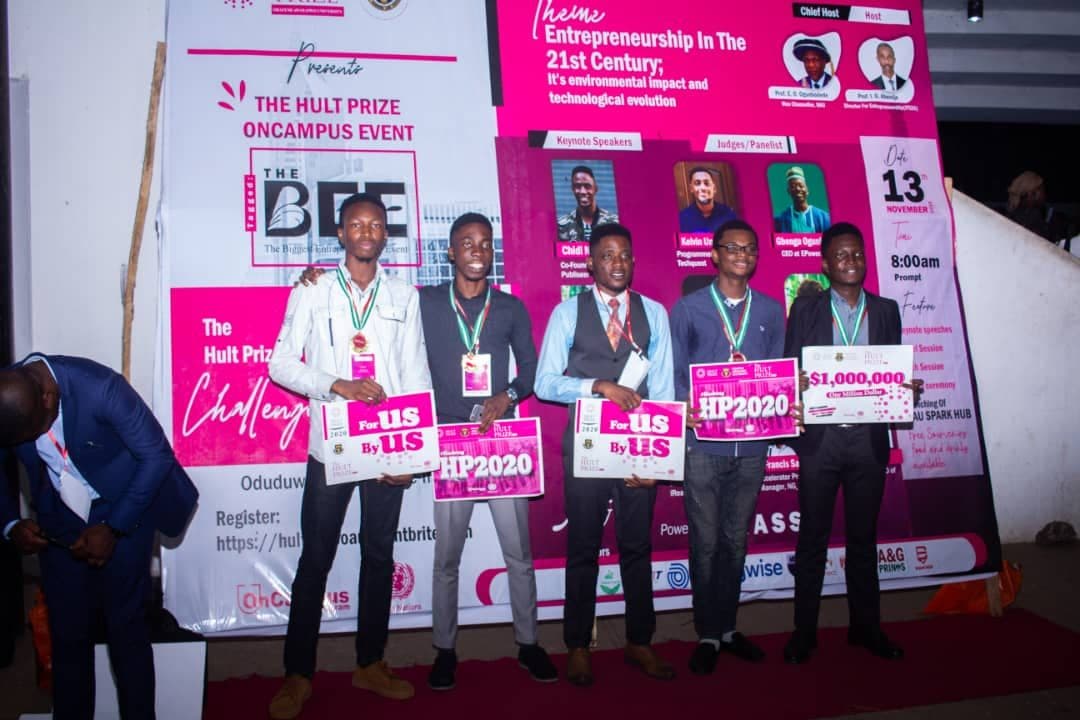
Forty-five participants entered. Thirteen teams formed and were taken from problem identification through human-centred ideation, business-model work and mentorship to pitch-ready. Six reached the Grand Finale, judged by university leadership and industry. The summit then opened the programme to more than a hundred and fifty students and connected them with entrepreneurs and development stakeholders.
- 01
Orientation
- 02
Design thinking
- 03
Business development
- 04
Mentorship
- 05
Pitch training
- 06
Screening
- 07
Grand finale
- 08
Youth Entrepreneurship Summit
- 09
Feedback & recognition
05 —
The process
The organising team worked under real financial and logistical constraints. We leaned on strategic partnerships and in-kind support, delivered stages in physical and virtual formats depending on what resources allowed, and refused to cut stages to fit the budget.
During the final pitch, the power went out. The eventual winners, Al-Sesi Technologies, an AI-powered early health assessment venture, finished the full pitch from printed materials with no slides. That became the programme's defining moment, and a fair summary of what building here is like.
06 —
The result
First place went to Al-Sesi Technologies, second to EduThrive, an adaptive learning platform, and third to Heritage Pair, a sustainable enterprise around local heritage products. One team advanced to the national stage of the Hult Prize. The programme ranked in the top 5% of on-campus programmes in its region and the top 25% worldwide.
Eighty-plus people remain active in the campus innovator network that grew out of it, and several teams are in post-programme mentorship. On the strength of the cycle I was nominated to serve as the next Campus Director.
07 —
What I learned
Programmes outlive events. The eighty-person network that remained after the finale is worth more than the finale, and a stage that everyone passes through is worth more than a prize that one team wins.
08 —
What's next
The next cycle as Campus Director, with Innovate Club UDUS as the permanent home for the network the programme created.